Healthcare organizations across the globe are struggling to keep their workforce staffed. From hospitals, clinics to diagnostic centers and home healthcare providers, the challenge is the same. Roles stay open for months making the teams operate understaffed. All this eventually leads to patient care suffering and staff’s mental being is also compromised.
Recently healthcare recruitment challenges have reached a critical point. According to global workforce studies, the healthcare talent shortage is expected to exceed 10 million professionals by 2030. In some regions, staffing shortages in healthcare 2026 are already being projected as a crisis level concern.
This raises an important question many healthcare leaders are asking today. Why is healthcare hiring so hard despite competitive salaries and growing demand?
Reason is hidden behind a mix of workforce shortages, burnout, compliance barriers, outdated hiring processes, and rising competition for skilled professionals.
Taking all into consideration, I have broken down some of the hard-hitting real reasons behind healthcare hiring problems and compiled a list of expert backed fixes that actually work. Let’s understand the challenges first.
Top Reasons Why Hiring Healthcare Roles Is So Difficult
As understood already, hiring healthcare roles is not difficult because of one single factor. It is the result of multiple challenges stacking up at the same time.
- Patient demand continues to rise due to aging populations and chronic diseases.
- The supply of qualified professionals is not keeping pace with the demand.
- Burnout in healthcare has pushed many skilled workers out of the industry entirely.
- Healthcare organizations also operate under strict compliance requirements, licensing rules, and credentialing processes that slow down the complete healthcare hiring process.
When combined with recent AI hiring platforms for healthcare, many orgs have spotted significant change yet many others still seem to struggle.
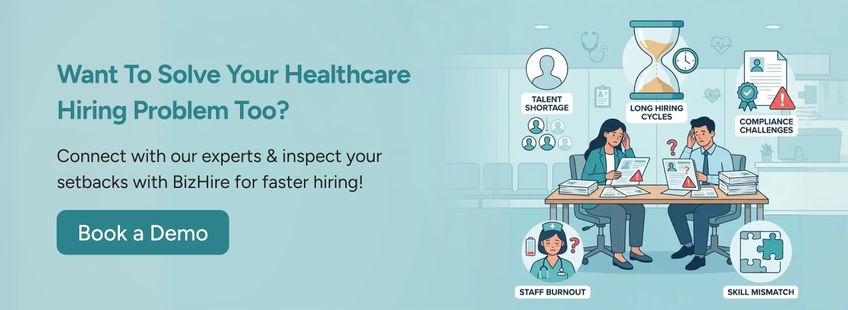
Key Healthcare Recruitment Challenges and Their Impact
Below is a clear breakdown of the most common recruitment challenges in healthcare industry settings and how they affect organizations.
1. Talent Shortage
The healthcare workforce shortage is driven by limited skilled professionals entering the field and high retirement rates among experienced workers.
Impact
Due to this vacancies remain open for extended periods. Teams work understaffed. Remaining employees face higher workloads, increasing burnout.
2. Staff Burnout
Long shifts, emotional stress, and high patient volumes lead to burnout in healthcare professionals.
Impact
High attrition rates increase healthcare recruitment issues and raise hiring costs.
3. Licensing and Credentialing Delays
Healthcare roles require extensive credential verification, background checks, and licensing approvals.
Impact
Such long background checks form slow hiring that in turn leads to missed candidates who accept faster offers elsewhere.
4. Compliance and Regulations
Healthcare compliance requirements vary by region, role, and facility type.
Impact
Recruiters have to spend more time on paperwork than candidate engagement.
5. High Competition for Talent
Private hospitals, global healthcare employers, and telehealth companies compete for the same professionals.
Impact
Rising salary expectations and increased recruitment costs make it harder for recruiters to hire faster in defined budgets.
6. Long Hiring Cycles
Manual processes, fragmented systems, and poor visibility into candidate pipelines make it extremely hard to accomplish the entire hiring process on time.
Impact
Delays in onboarding lead to staffing shortages and compromised patient care.
Which Healthcare Roles Are Hardest to Hire?
Definitely every recruiter from healthcare would have a different story when it comes to hard to fill roles. But some roles are consistently harder to fill due to demand and skill scarcity. Those are :
Nursing roles are at the top of the list. The global nursing shortage continues to grow, with estimates suggesting a shortage of over 6 million nurses worldwide.
Physician shortage is another major concern, especially in primary care, emergency medicine, and rural healthcare facilities.
Allied health professionals such as radiology technicians, lab technologists, respiratory therapists, and physiotherapists are also in short supply.
Mental health professionals are increasingly difficult to hire as patient demand rises faster than workforce growth.
These healthcare hiring problems affect not just recruitment teams but also the entire healthcare delivery systems.
Expert Fixes to Overcome Healthcare Recruitment Challenges
Solving healthcare recruitment issues requires a strategic shift rather than short term fixes. Yet here are some ultimate hacks that you can use to hire healthcare professionals without compromising over their skills:
1. Accelerate Hiring Without Sacrificing Quality
Reduce manual screening, shorten interview cycles, and maintain consistent candidate communication to prevent drop-offs while competing effectively for in-demand healthcare professionals.
2. Build Always-On Talent Pipelines
Create pre-screened talent pools of nurses, clinicians, and allied professionals to minimize urgent hiring and make sure of staffing readiness during seasonal demand spikes or emergencies.
3. Screen Clinically Relevant Skills With Data
Use data-driven evaluation to assess certifications, clinical experience, and role relevance contextually, improving hiring accuracy while reducing bias and compliance risks.
4. Align Recruitment, Compliance, and Leadership
Make sure your hiring teams, compliance officers, and leadership follow shared timelines and approval processes to eliminate delays and meet regulatory requirements efficiently.
5. Improve Retention to Reduce Hiring Pressure
Address burnout, workload balance, and career development to reduce attrition, protect workforce stability, and lower long-term recruitment costs.
6. Scale Hiring With Automation and AI
Take advantage of top AI recruitment tools to improve pipeline visibility, handle high application volumes, and free recruiters to focus on candidate engagement and decision-making.
Role of Technology in Fixing Healthcare Hiring Challenges
Technology plays a critical role in addressing healthcare recruitment challenges at scale. Surely many find it scary as taking care of a human's sensitive health can be a bit tricky when its under a machine but when its trained correctly there is no turning back. You get
1. Automated Screening & Shortlisting
AI healthcare recruiting software automates resume screening, credential tracking, and candidate shortlisting, reducing manual workload and accelerating recruiter decision making.
2. Centralized Hiring Visibility
Healthcare recruitment software centralizes candidate data, open roles, and compliance checkpoints, giving recruiters end-to-end visibility across the entire healthcare hiring lifecycle.
3. Faster Candidate Engagement
Recruitment automation shortens hiring cycles and ensures qualified healthcare candidates are engaged early before competitors extend offers.
4. Reduced Time to Hire
Organizations using AI-driven recruitment tools report up to a 40 percent reduction in time to hire along with improved hiring accuracy.
5. Human-Led, Technology-Supported Hiring
AI does not replace recruiter judgment. It removes operational friction so recruiters can focus on relationships, candidate experience, and quality hiring.
Read More: How to Pick the Best AI Recruitment Tool? HR-verified Guide
Checklist: Is Your Healthcare Hiring Gaining Speed or Falling Behind?
Use this quick checklist to assess whether your healthcare recruitment process is moving at the pace today’s talent market demands or quietly losing qualified candidates to faster competitors.
- Are open healthcare roles staying vacant longer than 30 to 45 days?
Extended time-to-fill often signals process bottlenecks, manual screening, or delayed decision-making that discourages in-demand clinicians.
- Do recruiters spend more time screening resumes than engaging candidates?
When manual resume reviews dominate recruiter time, candidate communication and relationship-building suffer.
- Is credential verification slowing down shortlisting and interviews?
Disconnected credential tracking creates delays and increases compliance risks in regulated healthcare hiring.
- Are qualified candidates dropping out mid-process?
High drop-off rates usually point to long hiring cycles, poor communication, or lack of visibility into next steps.
- Is hiring data scattered across emails, spreadsheets, and tools?
Fragmented systems reduce accountability and make it difficult to track hiring progress in real time.
-
Can you confidently measure time to hire, quality of hire, and compliance readiness? If these metrics are unclear, it becomes difficult to optimize or justify hiring decisions.
-
Are competitors making offers before your interviews are completed?
Losing candidates late in the funnel is a strong indicator that your hiring speed is not market-aligned.
Future of Healthcare Recruitment
The future of healthcare hiring will be shaped by data driven decision making, automation, and workforce planning. Especially when AI has arrived its hard to look back onto the manual repetition after all.
Healthcare workforce shortage solutions will increasingly rely on predictive analytics to anticipate hiring needs before shortages occur.
- AI powered recruitment systems will support faster credential checks, better candidate matching, and smarter workforce allocation.
- Flexible staffing models and hybrid care delivery will change how and where healthcare professionals work.
Organizations that modernize their healthcare hiring process today with good AI hiring tools will be better positioned to handle future demand without compromising patient care. Along with that they can make faster well-informed decisions in saving the lives of their patients.
Conclusion
Healthcare recruitment challenges are complex, interconnected, and growing. From nursing shortage and physician shortage to burnout and compliance delays, the pressure on hiring teams is immense.
However, these challenges are not unsolvable. By adopting smarter processes, investing in healthcare recruitment solution strategies, and leveraging technology, organizations can regain control of their hiring outcomes.
The healthcare industry cannot afford slow, manual hiring anymore. The future depends on faster, more resilient, and more human centered recruitment systems.
FAQs
Healthcare hiring is difficult due to workforce shortages, burnout, licensing delays, and high competition for talent.
The biggest challenge is the healthcare talent shortage combined with long hiring cycles.
Nurses, physicians, allied health professionals, and mental health specialists are hardest to hire.
Staffing shortages increase workloads, burnout, and risk of medical errors, impacting patient outcomes.
Healthcare hiring can take 45 to 90 days depending on role complexity and credentialing.
Technology cannot replace talent but can significantly reduce hiring delays and improve workforce planning.