Most startups start hiring with a spreadsheet. Then it gets chaotic. Resumes pile up in email inboxes, follow-ups fall through, and good candidates go quiet because nobody remembered to check back in.
So you start looking for a solution. You search "hiring software" and immediately hit a wall of acronyms. ATS. CRM. Recruitment CRM. Talent pipeline software. What is the difference? Do you need one or both?
The confusion is real, and it costs startups time and money every single day.
But before you look at any AI hiring tool, you need to understand what each type of software actually does and which problem it solves for your specific stage and hiring need.
Let's break it down clearly.
What Is an Applicant Tracking System (ATS)?
An Applicant Tracking System, or ATS, is software that helps you manage candidates who have already applied for a role.
Think of it as a control centre for your active hiring pipeline. When someone submits an application, the ATS captures their information, organises it, and helps your team move that person through the stages of your hiring process, from screening to interview to offer.
Key things an ATS does:
- Collects and stores resumes from job boards and your careers page
- Parses resume data automatically so you are not doing it by hand
- Organises candidates by job, stage, and status
- Sends automated updates and rejection emails
- Tracks interview schedules and feedback from your team
- Generates reports on how many applications you received, how fast you hired, and where candidates dropped off
Who is an ATS best for?
- Companies with open roles that need filling right now
- Teams managing a high volume of inbound applications
- Hiring managers who need a clear view of where every candidate stands
According to Jobscan, over 98% of Fortune 500 companies use an ATS, and adoption among startups and SMBs has grown significantly as hiring volume increases.
What Is a Recruitment CRM?
A Recruitment CRM, which stands for Candidate Relationship Management, is software designed for building and maintaining relationships with candidates before they apply for a role.
Where an Applicant Tracking System handles candidates who have already raised their hand, a CRM helps you proactively build a pipeline of people who might be a great fit in the future, including passive candidates who are not actively job hunting but might be open to the right opportunity.
Key things a Recruitment CRM does:
- Stores profiles of candidates you have sourced or met at events
- Sends personalised outreach and follow-up sequences
- Tracks every interaction and conversation over time
- Helps you run talent campaigns to keep your pipeline warm
- Nurtures passive candidates so they think of you when they are ready to move
- Feeds qualified candidates into your ATS when roles open up
Who is a Recruitment CRM best for?
- Companies hiring for competitive, hard-to-fill roles
- Teams that want to build a long-term talent pipeline rather than starting from scratch every time a role opens
- Recruiters who work with passive candidates or executive-level hires
A LinkedIn Talent Trends report found that 70% of the global workforce is made up of passive candidates. A CRM is how you reach them.
ATS vs CRM Comparison Table
How an ATS Works
Here is the typical flow when an ATS is running your hiring process:
1. Job is posted on your careers page, LinkedIn, Indeed, or other boards
2. Applications come in and the ATS automatically captures each one
3. Resume parsing pulls out key information like skills, experience, and education
4. Screening filters can automatically flag or sort candidates based on criteria you set
5. Your team reviews shortlisted candidates inside the ATS dashboard
6. Interviews are scheduled with calendar integrations and automated reminders
7. Feedback is collected from all interviewers in one place
8. Offers go out and the ATS tracks acceptance status
9. Reports are generated so you can see what worked and what did not
The whole process stays in one place. Nothing gets lost in email threads.
How a Recruitment CRM Works
A CRM works at an earlier stage. Here is what that looks like in practice:
1. You source or meet a candidate at an event, on LinkedIn, or through a referral
2. Their profile is added to the CRM with notes on their background and interest level
3. You segment your pipeline by role type, skills, seniority, or readiness
4. Personalised outreach is sent through automated sequences or direct messages
5. Interactions are tracked so anyone on your team knows the full history
6. Candidates are nurtured over time with relevant content, updates, and check-ins
7. When a role opens, you have a warm pool ready to reach out to immediately
8. Qualified candidates are moved into your ATS to begin the formal process
The result is that you are never starting your search from zero.
When Should Companies Use an ATS?
Use an ATS when:
- You have a specific open role and candidates are already applying
- Your team is spending too much time sorting through applications manually
- You need a structured, consistent process from application to offer
- You want to reduce time-to-hire and avoid candidates slipping through the cracks
- Compliance and record-keeping are important in your industry
Stat to know: According to SHRM, the average cost-per-hire is $4,700 in the US. A well-configured ATS can cut that significantly by reducing manual work and shortening hiring timelines.
When Should Companies Use a Recruitment CRM?
Use a CRM when:
- You are hiring for roles where great candidates are rarely actively looking
- You want to stop starting every search from scratch and build a reusable pipeline
- Your team does outbound sourcing, attends networking events, or runs referral programs
- You have high-growth hiring plans and need a steady flow of pre-warmed candidates
- Candidate experience and employer brand matter to your hiring strategy
Stat to know: According to LinkedIn, companies with strong talent pipelines fill roles 40% faster than those that rely purely on inbound applications.
Why Modern Recruiters Use Both ATS and CRM
Here is the simple reality: an ATS and a CRM solve two different problems. One is not a replacement for the other.
An ATS manages the people already in your process. A CRM builds the pool of people who could be in your process. Together, they create a hiring machine that is both efficient and proactive.
If you only have an ATS, you are always reactive. A role opens, you post it, you wait, and hope the right person applies.
If you only have a CRM, you have warm relationships but no structured way to move people through the actual hiring process when a role opens. The companies that hire well and hire fast use both.
Read More: How AI Recruitment Software Can Reduce Hiring Bias
Benefits of Using ATS and CRM Together
| Recruitment Area | Traditional Hiring | ATS + CRM Recruitment |
|---|---|---|
| Candidate Tracking | Manual spreadsheets | Automated workflows |
| Talent Pipeline | Limited or nonexistent | Continuously growing |
| Candidate Engagement | Inconsistent | Personalised at scale |
| Hiring Speed | Slow, reactive | Faster, proactive |
| Recruiter Productivity | Low due to manual tasks | Higher with automation |
| Hiring Quality | Inconsistent | Better matching |
| Reporting | Manual and delayed | Real-time analytics |
The combined approach means:
- Fewer surprises. You always have candidates ready when a role opens.
- Better candidate experience. People are not left in the dark at any stage.
- Shorter time-to-hire. Pre-warmed candidates move through the process faster.
- Stronger employer brand. Consistent communication makes your company look organised and caring.
- Smarter decisions. Data from both tools gives you a full picture of your hiring health.
Common ATS and CRM Features to Look For
Whether you are evaluating a standalone tool or an all-in-one platform, here are the features worth prioritising:
For ATS functionality:
- Resume parsing and smart candidate matching
- Customisable hiring pipeline stages
- Interview scheduling with calendar sync
- Automated candidate communication
- Team collaboration and interview feedback tools
- Compliance and data storage controls
- Reporting on time-to-hire, source quality, and funnel conversion
For CRM functionality:
- Contact and profile management for sourced candidates
- Email outreach and follow-up sequences
- Candidate segmentation by skills, role type, or readiness
- Interaction history and notes across your team
- Pipeline analytics showing engagement rates
- Integration with your ATS so warm candidates flow across automatically
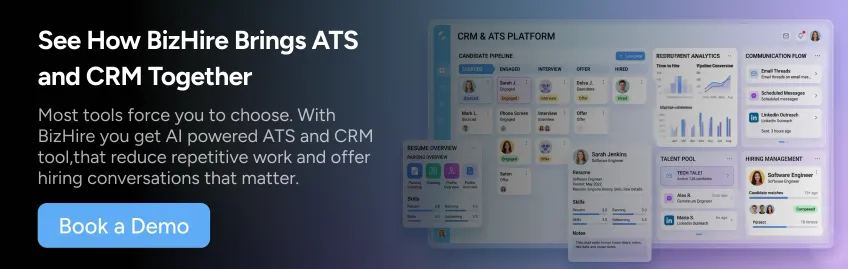
BizHire's AI-powered candidate matching and automated hiring workflows cover both sides of this equation, so your team is not stitching together two separate tools.
ATS vs CRM: Which One Does Your Business Need?
Use this quick guide to decide:
You need an ATS if:
- You have open roles right now and need to manage applicants
- You are dealing with high application volume
- Your process is inconsistent or relies on email and spreadsheets
You need a CRM if:
- You hire for competitive roles where great people are hard to find
- You want to build a pipeline before roles even open
- You do active sourcing, referrals, or event-based recruiting
You need both if:
- You are growing fast and need a sustainable, repeatable hiring process
- You care about both efficiency (filling roles fast) and quality (finding the right people)
- You want hiring to be proactive rather than reactive
The honest answer for most startups past their first 20 hires: you need both.
How AI Is Changing ATS and CRM Platforms
AI is making both tools significantly more powerful, and it is changing what "good" looks like in hiring software.
In ATS platforms, AI now helps with:
- Automatically ranking and scoring candidates based on job requirements
- Screening out duplicate applications and low-quality submissions
- Writing and improving job descriptions to attract better applicants
- Predicting which candidates are most likely to accept an offer
- Flagging potential bias in screening criteria
In CRM platforms, AI now helps with:
- Identifying which passive candidates in your database are most likely to be open to a move right now
- Personalising outreach messages at scale without sounding robotic
- Predicting when a candidate relationship is cooling and flagging it for follow-up
- Suggesting the right time and channel for re-engagement
According to a Gartner report, by 2026 more than 80% of enterprise hiring teams will be using AI-powered recruitment tools in some capacity. For startups, adopting these tools early is a real competitive advantage in talent markets.
Read More: How to Reduce Hiring Bias with AI Recruitment Software
Conclusion
The ATS vs CRM question is not really about choosing one over the other. It is about understanding what each tool does and making sure you have the right coverage for where your hiring actually happens.
An ATS keeps your active hiring process clean, consistent, and fast. A CRM makes sure you are never scrambling to find great candidates because you have been building relationships all along. Together, they turn hiring from a reactive scramble into a planned, repeatable process that keeps getting better.
If you are ready to stop choosing between the two and start using both in one place, BizHire was built for exactly that.
Frequently Asked Questions
An ATS manages active applicants in your pipeline; a CRM builds relationships with candidates before they apply.
No. A CRM handles relationship-building before applications; an ATS manages the formal hiring process after.
Most growing startups benefit from both to stay proactive and manage active hiring at the same time.
It depends on your stage. Active hiring needs an ATS; building a future pipeline needs a CRM.
Faster hiring, stronger pipelines, better candidate experience, and smarter data-driven decisions across the full process.