

It's 9 AM on a Monday.
Your VP of Engineering has ghosted three AI-screened candidates this week, not because they were underqualified, but because when he asked "why did the system rank this person top #1?", nobody had an answer.
So now he's back to doing his own phone screens. And your carefully built AI-assisted process? Dead on arrival.
Don’t feel like the failure of this whole era, it's common and it's NOT your fault entirely. It's a trust problem. And it's more common than most HR leaders want to admit.
For those living under the rock, let’s first understand AI scoring and understand how you can escape from this deadly game of explanation with new tech.
What Are AI Hiring Scores (And How They Actually Work)
AI hiring scores are numerical ratings generated by algorithms that evaluate candidates based on factors like resume data, skills assessments, job description match, and sometimes behavioral or communication signals. The system processes hundreds of data points and outputs a single number, say, 74 out of 100 or 7.5/10 etc.
So the problem is not in the scoring unless your code is constantly lagging or making mistakes while scoring the same CV differently everytime. The issue is in what's comes after it.
Most AI hiring tools stop at the number. They don't explain
- Which skills pushed the score up,
- Which gaps pulled it down, or
- How two candidates with a score of 74 are actually very different hires for very different reasons.
The algorithm did its job. But it left your hiring manager holding a number they can't defend in a debrief.
According to a 2023 IBM Institute for Business Value report, 41% of HR leaders cite lack of explainability as the #1 barrier to AI adoption in talent functions. In short for them the tool exists but the trust doesn't.
Why Hiring Managers Don't Trust AI Scores
Here's what's actually happening inside that VP of Engineering's head when he sees an AI-generated shortlist.
He's not thinking "this technology is wrong." He's thinking: "If I hire this person and it goes badly, can I explain why I chose them?"
Hiring managers, especially in mid-to-large organizations, are accountable to department heads, leadership, and sometimes even boards.
Every hire is a business decision with consequences. A black-box score doesn't just feel unhelpful, it feels like a liability.
"The most dangerous phrase in hiring is 'the algorithm said so.' Leaders need to own their decisions, and that means understanding them first." Liz Ryan, Founder & CEO, Human Workplace, Forbes Contributor
There's also a deeper anxiety at play. Most hiring managers have been burned before a candidate who interviewed beautifully and underperformed within 90 days. When AI produces a high score with no explanation, it doesn't reduce that anxiety. It just replaces one gut feeling with another.
All this leads to override rates going up. Manual screening creeps back in. The AI scoring tool for CVs becomes shelf-ware that HR paid for and nobody uses.
A 2024 LinkedIn Future of Recruiting report found that only 27% of talent professionals say their hiring managers are fully confident in AI-assisted candidate recommendations. That's an adoption crisis hiding inside a technology budget.
What Is Explainable AI in Recruitment?
Explainable AI (XAI) in recruitment is not a feature, it's a design philosophy. It means building AI systems that don't just produce a score, but show their work. Instead of "Candidate Score: 74," an explainable AI system shows you:
- Score: 74
- Strong Python skills (9/10),
- Solid communication (8/10),
- System design gap identified (5/10),
- 3 of 5 required certifications matched.
That's a hiring decision you can walk into any boardroom and defend.
In technical terms, explainable AI uses methods like SHAP values, feature importance rankings, and decision trees to surface which factors influenced the final score and by how much. But you don't need to understand math. You just need to see the output and the output needs to make human sense.
The goal isn't to replace hiring manager judgment. It's to give that judgment something solid to stand on. Still understanding the justification yourself and presenting it in a board meeting are two very different worlds to live in.
How Explainable AI Fixes the Trust Problem
This is where it gets practical. Every objection a hiring manager has to show AI scores maps directly to something explainable AI is designed to address.
| Hiring Manager Concern | What They Expect From AI | How Explainable AI Solves It |
|---|---|---|
| "Why is this candidate ranked higher?" | Clear score explanation | Shows skill-level score breakdown per dimension |
| Fear of wrong hiring decision | Transparent evaluation | Explains experience, skills, and job relevance individually |
| Bias concerns | Fair candidate evaluation | Provides auditable, explainable scoring logic |
| Lack of confidence in AI | Trust and clarity | Shows exactly how and why the decision was made |
| Hard to compare candidates | Structured comparison | AI explains the differences between candidates clearly |
Notice what's happening in that table. Every concern isn't about the AI being wrong, it's about the AI being opaque.
Explainable AI doesn't need to be more accurate to earn trust. It needs to be more transparent.
"Trust in AI is not built by telling people the AI is trustworthy. It's built by showing them the reasoning and letting them verify it themselves."
Josh Bersin, Global HR Industry Analyst & Founder, The Josh Bersin Company
When a hiring manager can see the reasoning, they stop fighting the tool and start using it. That shift from resistance to adoption is what turns AI powered scoring tool for hiring from a cost line item into a competitive advantage.
Still the ones who are stuck in their manual processes, ever wondered how incredibly upskilling a basic AI hiring tool can be?
Difference: Traditional AI Hiring Tools vs Explainable AI Hiring Systems
If you're evaluating tools right now, or trying to figure out why your current AI setup isn't sticking with the hiring team, this comparison is worth printing out.
| Feature | Traditional AI Hiring Tools | Explainable AI Hiring Tools |
| Candidate scoring | Black-box composite scores | Transparent, dimension-level scoring logic |
| Trust level | Low managers can't interrogate the output | High reasoning is visible and auditable |
| Hiring manager confidence | Low leads to override or abandonment | High managers can defend shortlists confidently |
| Bias detection | Limited hard to audit what you can't see | Easier to audit and challenge specific signals |
| Decision clarity | No explanation provided | Clear reasoning for every score and ranking |
| Adoption by hiring teams | Low ghost tool after onboarding | Higher becomes part of the daily hiring workflow |
You can even paste this in front of your desk board too. The difference isn't just functional. It's cultural. Traditional AI tools ask your hiring team to trust a machine. Explainable AI tools give your hiring team a reason to trust.
Red Flags That Your AI Scoring Is a Black Box
Not sure if your current tool has an explainability problem? Here are three signals that should concern you.
1. You get a number, not a narrative.
If your AI output is a score without any skill-level breakdown or match reasoning, you're working with a black box. A score without context isn't insight, it's noise.
2. Your hiring managers are overriding AI recommendations.
More than 40% of the time. Override rates are a proxy for distrust. If your team is consistently going around the AI, they've already decided it doesn't explain itself well enough to be relied on.
3. You can't answer "why was this candidate rejected?"
Three weeks later. If there's no audit log, no stored reasoning for why a candidate was scored or ranked a certain way you don't just have a trust problem.
You may have a compliance problem. The EEOC's 2023 guidance on AI in employment specifically flags unexplainable automated selection tools as a potential disparate impact risk.
Now understanding all the reasons, fixes and red flags regarding your AI scoring, next finally make sure to utilise the tools correctly for maximum potential.
Real Use Cases Where Explainable AI Works Best
Explainable AI isn't just theoretical. It solves real friction points that HR managers face daily.
High-volume technical hiring
When you're screening 300+ applicants for a software engineering role, explainable AI lets you show your VP of Engineering exactly why the top 10 made the cut skill by skill. No more "can you send me the full resumes anyway?" follow-ups that eat your afternoon.
Cross-functional hiring panels
When multiple stakeholders are evaluating the same candidates, explainable scores create a shared reference point. Instead of five people with five gut feelings, you have one structured breakdown that the whole panel can react to.
Diversity and inclusion audits
If your company has committed to reducing bias in hiring, explainable AI gives you something to actually audit. You can review which signals influenced scores and flag patterns that may reflect historical bias in your job descriptions or evaluation criteria.
Defending decisions to leadership
This is the use case hiring managers care about most. When your CHRO asks "why did we shortlist these five and not those?" explainable AI gives you a documented, structured answer. That's not just good process. That's career protection.
Read more: How AI Recruitment Software Helps Reduce Bias in Hiring
How BizHire Makes AI Scores Your Strongest Hiring Argument
At BizHire, we've spent a significant amount of time talking to HR managers about why AI tools fail in practice and the answer is almost always the same: "My hiring managers just don't trust it."
That's why we built explainability into the core of BizHire's scoring engine, not just as a report you generate after the fact, but as the default output every time a candidate is evaluated.
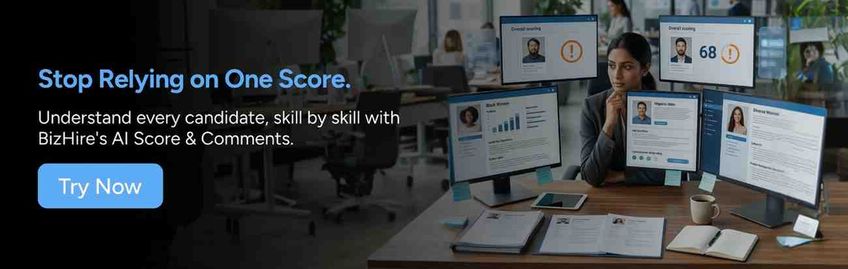
Every BizHire score comes with a dimension-level breakdown skills, experience relevance, communication, and AI review, so your hiring manager sees what drove the score, not just a number.
Every shortlisting decision is logged, so you have a full audit trail if you ever need to justify a decision to leadership or a compliance team. And the calibration dashboard lets you compare AI rankings against actual hire outcomes over time, so the model gets smarter the longer you use it.
The result isn't just faster hiring. It's a hiring process your team actually believes in, one where you walk into a debrief with a structured case, not a printout nobody can explain.
→ See how BizHire's explainable scoring works in a 15-minute demo. Book your slot here.
Conclusion
The reason hiring managers don't trust AI scores isn't irrational it's completely reasonable. They're being asked to stake their professional reputation on a number produced by a system that won't show its work.
Explainable AI doesn't ask for blind faith. It earns trust the same way a good hiring manager does by showing its reasoning, being transparent about its limitations, and giving people something solid to stand on.
If your AI hiring tool can't answer "why?" it's not a hiring tool. It's a liability.
The good news? That's a solvable problem. And the HR managers who solve it first are the ones who'll be known for modernizing their company's talent function not for the AI experiment that quietly failed.
FAQs
AI that shows how and why it scored or ranked a candidate.
Lack of transparency, fear of bias, and unclear decision logic.
By analyzing resumes, skills, experience, and responses against role-specific criteria.
Yes, when trained well and used with structured, validated processes.
Yes, if designed with unbiased data and monitored regularly.
Not mandatory, but it helps demonstrate fairness and reduce legal risk.


