

Hiring teams confront the challenge of operating under tight timelines, dealing with rising expectations, and handling an ever-increasing volume of applicants. The problem is not just the workload. It is the speed at which businesses change their needs.
Developers, analysts, designers, salespeople - each one brings a new skill puzzle. Recruiters are trying to catch up, but some parts of the workflow still seem to be slow.
That difference is the reason why companies are paying more and more attention to AI talent acquisition software. HR leaders are looking for tools that can increase the speed of work without losing the quality of the decision.
AI is a helper that can handle a large amount of data thus the recruiter can focus more on skill & conversation assessments from the talent in person.
The talent market is becoming more and more difficult, and the role of AI in recruitment is no longer just a trend but more of a standard for mid-sized and enterprise teams. This is the background for how AI is integrated in daily hiring tasks.
Why Talent Acquisition Should Use AI Today
Recruiters generally have access to more information than other departments combined. Each position comes with various documents and information like resumes, internal referrals, interview notes, scorecards, and expectations from hiring managers.
This is a lot to go through even for a very experienced person. Errors are made. Some of the good candidates are overlooked.
LinkedIn research indicates that almost 75% of hiring teams have difficulties in locating qualified technical candidates within the time frame set. This, in turn, leads the management to experiment with different tools that can shorten the waiting time and provide more clarity.
AI talent acquisition solution products do exactly that by cutting down routine tasks.
After some time, recruiters realize how much time AI saves them in the initial stages, and that is when they start feeling a better rhythm throughout their pipeline.
Firstly, the HR team gets a stable base from these benefits. With such a foundation, they get more confident in considering AI talent acquisition use cases and making a choice of those that naturally fit their recruiting cycle instead of having to change it.
10 Smart Use Cases of AI in Talent Acquisition
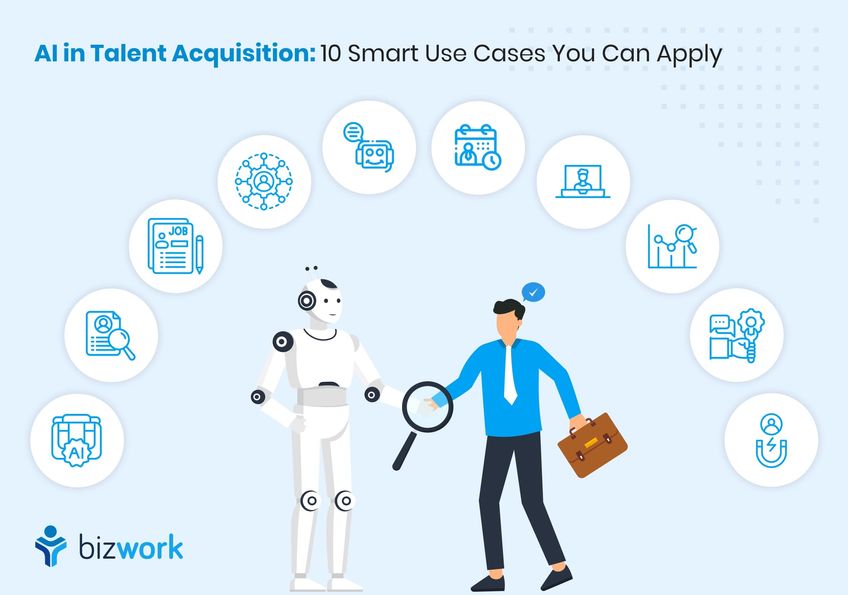
These ten are use cases which are implemented broadly by different recruiting departments. Each of them resolves an actual problem and can be easily integrated into the regular activities of HR.
1. AI Powered Candidate Sourcing
It took a lot of hours to find candidates. The recruiters were moving between portals, filters, and spreadsheets in a frenzy. The whole procedure is changed when a powerful AI recruitment platform is involved.
It doesn't only scan the multitude of sources but also returns the best profiles in line with the skills and the relevance of the person to the role.
Quickly teams see the impact of AI candidate sourcing on their work because of the fact that it drastically reduces the noise that masks talented people.
2. Automated Resume Screening
Hardly any task is more draining than that of screening because at the same time, the task requires accuracy and is performed under time pressure.
AI takes care of all the resumes on a large scale and selects those which are the best matches in terms of skills and reflects the job requirements. By using this method recruiters are freed from the tiring manual scanning sessions.
Technical recruiting gets more advantages from this point of view because smart recruiting systems can understand the frameworks and tech stacks better and with more structure.
3. Job Description Optimization
A JD is the basis of every subsequent hiring cycle. If the announcement of the post stays vague, the funnel will be filled with mismatched applicants.
An AI job description generator for recruiters can easily fix the problem of unclear lines and also put in the right keywords without lengthening the text unnecessarily.
This not only ensures that jobs are standardized between different departments but also that there is no confusion on the part of the applicants.
4. Skill and Competency Matching
Job titles can confuse. Candidates may have the skills even though their title is different.
AI understands the clustering of skills and compares them with the requirements of the job.
This is the point where AI recruitment analytics come in and give you more accurate results for shortlisting.
5. AI Chatbots for Candidate Queries and Pre-Screening
The majority of candidates wonder about the same thing. Details of the role, work setup, or interview rounds.
Chatbots give the answer immediately and collect the information needed from the conversation that helps the recruiter to be prepared for the next step.
This complements perfectly well with the advanced recruitment solutions that are employed by the busy HR teams who are juggling multiple roles at the same time.
6. AI Based Interview Scheduling
Problems with putting together a schedule arise when the calendars clash. AI not only finds open slots but also lets the other person know about it without the need for a lengthy email chain.
It informs candidates of any changes and therefore saves a recruiter's time from the usual back and forth of emails.
The time thus saved accumulates over the period of a month.
7. Video Interview Analysis
Some corporations deploy AI video interview software to examine the communication styles of a person during the first interview rounds. It focuses on listening to the person's voice, looking at the silence, and gauging general confidence.
The recruiter doesn't allow this device to decide the result. They use it just to have another point of view before coming to their own conclusion in talks with hiring managers.
They get a quick idea of candidate's presence this way.
8. Predictive Analytics for Hiring Decisions
Information about the previous employees is a great source of patterns for the future. Results, tenure, team suitability, personal growth, all of it can be helpful in predicting what kind of candidate will be successful.
AI combines all these indicators and thus acts as a data-driven decision support tool for hiring managers.
Recruiters are in charge of the final decision. The instrument only facilitates it by making the complex patterns more understandable.
9. AI for Technical Assessments
The engineering teams spend their time and energy on going through the tests that check the ability to code. The AI tool can evaluate the quality, logic, and correctness of the code quickly and without a junior developer having to slow down the process.
This elevates the teams' capability for maintaining the consistency of the assessment process among all applicants.
Those companies who are looking to hire developers are using this method very often so that they can ensure that their hiring process is impartial.
10. Automated Candidate Engagement and Follow-Ups
There are times when a candidate stops being interested because the communication has come to a halt. The AI-driven talent acquisition platform acts like a personal assistant who is always there, sends out reminder messages, shares the latest news, and keeps the dialogue going.
It offers the candidate the feeling that the company is valuing their time.
The recruiter is still very much in control while AI in recruitment is handling the routine messages.
All these use cases create impact only when they attach to the right stage of the hiring cycle, which leads into how HR teams fit them into a structured workflow.
How HR Teams Incorporate These Use Cases in Hiring Cycles
Every use case merges with the stages that are already there. Recruiters are not required to change their process. AI talent acquisition technology merely empowers the stage which is the most overwhelming.
Early stage support
By the aid of sourcing tools, resume filters, and JD enhancement features the first wave of manual checks is done very quickly and teams get to start with cleaner talent pools.
Mid stage stability
Skill matching tools, chatbots, scheduling systems, and assessment platforms lead the recruiters through the busiest part of the cycle where they need to be very accurate.
Late stage clarity
Predictive checks, video insights, and consistent communication tools allow teams to close roles faster and keep a nice ending going for candidates.
This naturally leads to a deeper question. How is AI integrated with usual hiring tasks without resulting in disorder?
How AI Supports the Recruiting Workflow
By the time a recruiter gets to work, there is generally a list of candidate applications to go through, a few quick replies to write, and updates that have to be given to the hiring managers.
While these things are simple, they are also quite draining since they consume a recruiter's focus.
As these AI-based recruitment software enters the scene, they change the pace because they are the ones handling such tasks that were eating up the productive hours.
Though the workflow remains the same, it seems to be lighter. AI defines the glimpses of the early steps and keeps the mid-stage duties at the same level.
The difference is that the repetitive works get done and recruiters realize that they have been given more time. The effect is noticeable at the different crucial areas such as:
- Smarter sourcing: AI goes through large talent pools and presents the profiles that are the best fit for the true requirements of the role.
- Clean resume review: Resumes are being sorted with the most relevant skills highlighted, thus, the recruiters are saved from the lengthy manual checks.
- Accurate skill matching: AI identifies skill clusters and, in a very organized manner, matches them to the expectations of the job.
- Simpler scheduling: By automatically doing calendar checks and slot suggestions the follow-up loops are shortened significantly.
- Consistent candidate updates: If routine messages are sent timely then candidates will be informed without any delays.
This arrangement provides HR teams with more value from an AI talent acquisition software without disrupting their workflow. As teams start using these tools, they get new tasks appearing because the benefits remain if the risks are kept under control.
Challenges and Responsible Use of AI in Hiring
AI gives hiring teams a lift, but HR leaders care about safety and fairness too. Each challenge below explains where attention is needed and how to keep the system reliable.
| Challenge | What it means | Responsible use |
|---|---|---|
| Bias in data | AI learns from past hiring habits. Bad patterns create bad results. | Use mixed datasets and review outputs, reduce bias in hiring. |
| Limited transparency | Recruiters may not understand why a tool ranked certain profiles higher. | Choose tools that show clear scoring logic and offer visibility. |
| Over reliance on automation | Teams may trust AI suggestions too easily. | Treat AI as a support arm and keep final calls with recruiters. |
| Privacy concerns | Candidate data stays sensitive. | Pick platforms with strong privacy control and limited access. |
| Tool misalignment with job needs | Niche tech roles confuse some tools. | Use real job examples during setup and involve hiring managers early. |
| Compliance issues | Automated hiring follows regional rules. | Check local laws and pick vendors that fit legal expectations. |
Being open about these challenges builds trust. It also helps companies get the benefits of AI in talent acquisition without hurting fairness or accuracy.
Conclusion
Artificial intelligence has been integrated in a very effective manner in talent units. This is not because it substitutes human judgement, but rather, because it alleviates the extra burden that extends the hiring cycles.
Recruiters have more time for conversations and can make more accurate decisions. Candidates receive quicker replies and the process is more user-friendly.
Talent acquisition becomes stronger when skill data, automation, and recruiter experience are combined. Tech hiring companies are the ones who feel this change the most, and an IT service management platform can help make sense of increasingly complex tech skill signals.
AI powered talent acquisition is there to stay. It is not flashy. Just practical and reliable for those teams who want consistent hiring results.
FAQs
It cuts time spent on sourcing, screening, matching, scheduling, and candidate replies. Recruiters spend less time on repetitive tasks and more time speaking with shortlisted candidates.
Most platforms are built for HR teams, not engineers. Basic training is enough. Recruiters focus on inputs and results while the system handles the data work in the background.
No. It helps with the heavy work that slows teams down. Recruiters still handle interviews, culture fit, final decisions, and relationship building. AI simply keeps the flow steady.
Teams usually notice changes within weeks. Sourcing becomes cleaner, scheduling gets faster, and drop-offs reduce. Bigger improvements appear once more hiring cycles run through the platform.
Reputable tools use encryption, access controls, and strict user rules. Companies also audit data sources and check for bias to keep decisions fair for every candidate.


